Most of what you've read online against this fish is ten years out of date or aimed at uncertified bulk products you were never going to buy anyway. For anyone who values smart kitchen management, I cook basa often, pull the nutrition labels myself, and have read what the certification programs actually require. The real answer about whether it's good for you turns out to be shorter than the rumor cycle suggests, and it's worth getting right before your next grocery run.
This piece covers what basa actually is, what's in it, what the internet keeps getting wrong, and how to buy and cook it like you mean it.
TL;DR Quick Answers
basa fish
Basa is a freshwater catfish (Pangasius bocourti) farmed in Vietnam and sold in U.S. grocery freezers as a mild, low-cost white fish. A 100-gram cooked fillet runs 90 to 100 calories with 18 to 22 grams of protein, low fat, and very low mercury. It's a healthy, budget-friendly weeknight protein when sourced from BAP, ASC, or GlobalG. A.P.-certified farms. The only version worth skipping is an unbranded bulk product without a country-of-origin label.
Key facts:
Scientific name: Pangasius bocourti, a freshwater catfish native to the Mekong and Chao Phraya river basins.
Nutrition per 100g cooked: 90 to 100 calories, 18 to 22g protein, 2 to 4g fat, almost no carbs.
Mercury level: Below 0.1 ppm on average — well within the FDA's low-mercury "Best Choices" range.
What to look for on the label: Country of origin (Vietnam), a BAP/ASC/GlobalG. A.P. certification seal, and the Latin name Pangasius bocourti.
Best preparations: Pan-sear, blackened, beer-battered, fish tacos, Thai green curry. Pull at 135°F internal.
Sustainability rating: BAP-certified pangasius is rated a "Good Alternative" by Monterey Bay Aquarium's Seafood Watch.
Top Takeaways
• Basa is Pangasius bocourti, a freshwater catfish farmed mostly in Vietnam.
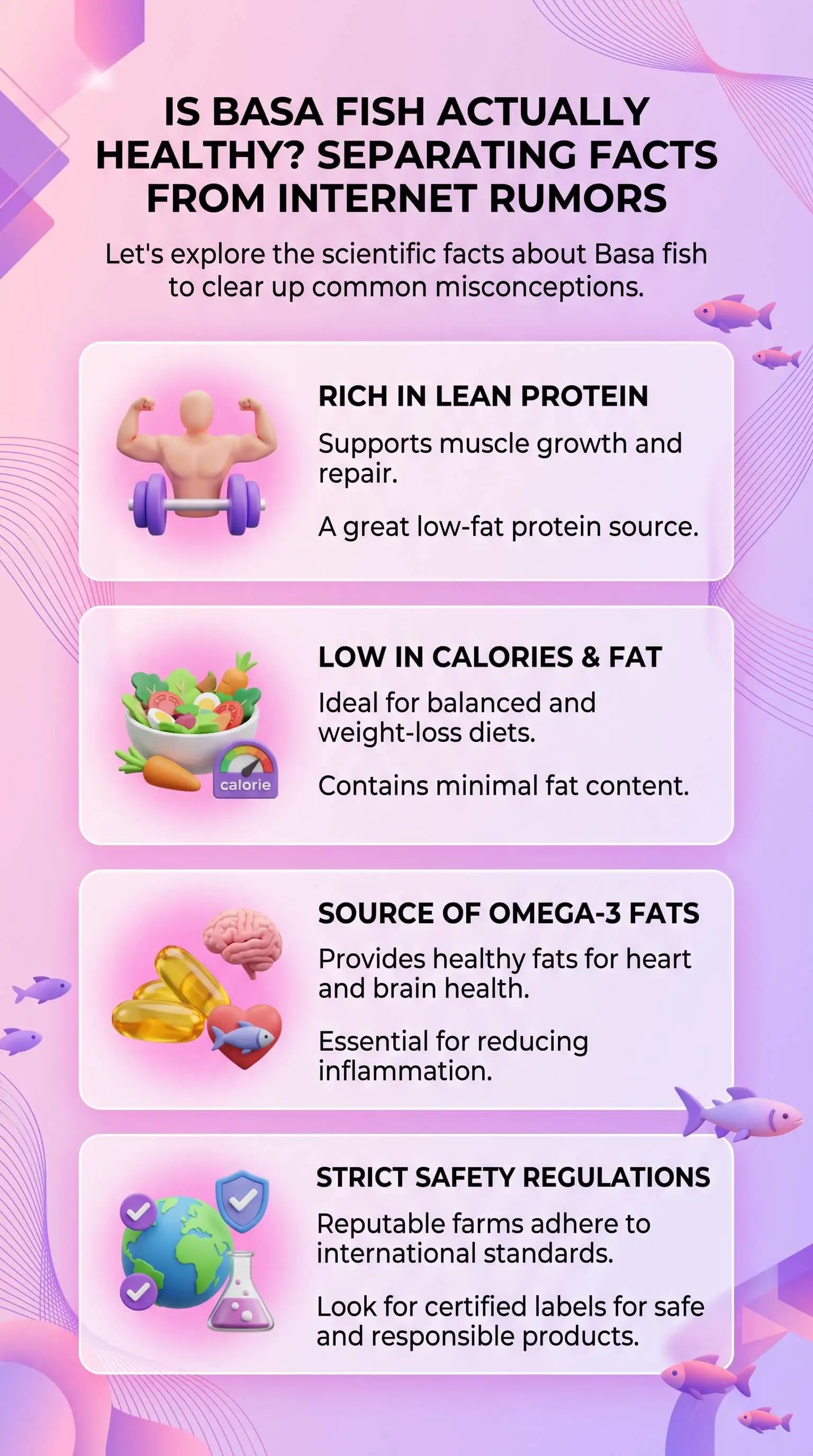
• It's lean, high in protein at 18 to 22 grams per 100 grams, and very low in calories.
• It is not a top-tier omega-3 fish. That title belongs to salmon, sardines, and mackerel.
• The internet's biggest rumors are out of date or apply mainly to uncertified products.
• Buy fillets carrying BAP, ASC, or GlobalG. A.P. certification with a clear country of origin.
• Cook it gently. Pull at 135°F internal and let carryover finish.
• Treat unbranded, no-country-listed bulk basa as an unknown and pass on it.
What basa fish actually is
Basa is a freshwater catfish. Its scientific name is Pangasius bocourti, and it's native to the Mekong and Chao Phraya river basins in Southeast Asia. Almost every basa fillet sold in the United States starts life on a Vietnamese pond farm before getting frozen and shipped over.
You'll see the same fish labeled as pangasius, tra, bocourti, river cobbler, or swai. Those names get used loosely, and they aren't all interchangeable. Basa specifically is Pangasius bocourti. Swai is Pangasius hypophthalmus. Same family, different species, slightly different texture and farming standards. Most of the FDA labeling fights over the years trace back to that confusion.
Nutrition that actually means something
A 100-gram cooked fillet of basa lands roughly here:
• 90 to 100 calories
• 18 to 22 grams of protein
• 2 to 4 grams of total fat
• Almost no carbohydrates
• A small but real dose of omega-3 fatty acids
• Useful amounts of vitamin B12, selenium, and phosphorus
Lean fish, high protein, very low calorie density. If your goal is loading up on omega-3s, salmon and sardines beat basa by a wide margin. If your goal is affordable lean protein for a Tuesday dinner, basa stacks up well against cod and tilapia at roughly a third of cod's price.
The internet rumors, what's true and what's not
“Basa is farmed in polluted Mekong River water.”
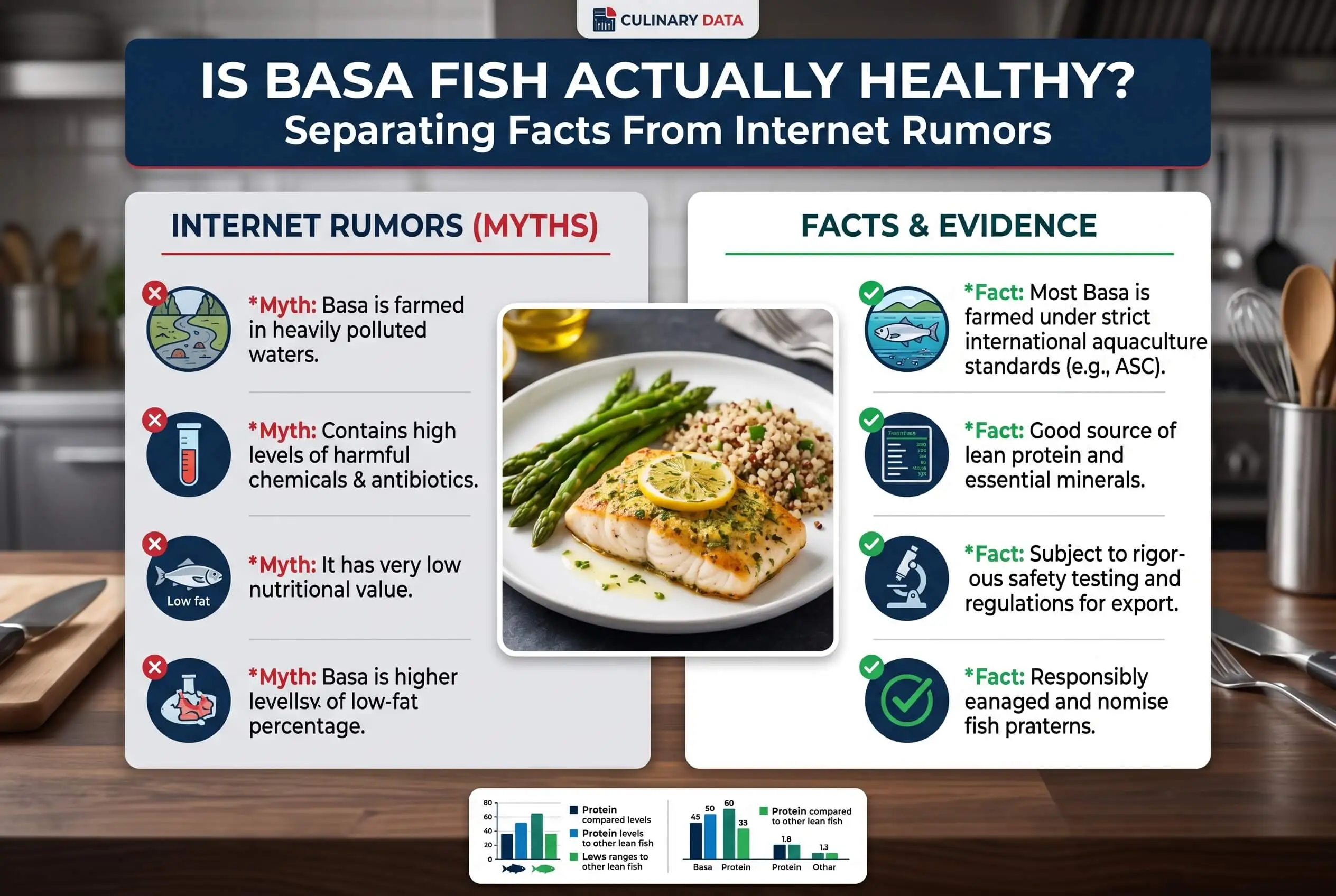
Half true, badly out of date. Modern basa farms operate as pond-based aquaculture systems rather than river capture. The legitimate concern centers on water discharge from those ponds back into the river, which is exactly what the BAP, ASC, and GlobalG. A.P. certifications audit against. Buy certified, and this concern shrinks.
“Basa is full of antibiotics.”
Pangasius has shown up historically on the list of imported seafoods with the highest frequency of veterinary drug residue violations. That's a real thing, and it's why the certifications matter. The FDA inspects and refuses non-compliant lots, though independent researchers have noted that the U.S. testing rate runs well behind the EU. The grade matters here. Certified product is a different animal than uncertified bulk imports.
“Basa is the same as catfish.”
Same family, different species. The FDA has gone back and forth on labeling for years, and U.S. domestic catfish farmers spent a long time fighting to keep “catfish” off basa packaging, a distinction that matters just as much when shoppers are comparing basa with skate fish or other seafood options at the counter. If you specifically want American channel catfish, that's what the label needs to say.
“Basa has no nutritional value.”
Wrong. The protein and B-vitamin numbers above settle the question. Basa isn't as nutrient-dense as salmon, but no white fish is. “No nutritional value” reads like a meme. It isn't a fact.
Buying and cooking it without overthinking
When I'm picking basa up, I look for three things on the label. Country of origin. A recognized certification (BAP, ASC, or GlobalG. A.P.). And the species name in Latin. If the package reads Pangasius bocourti and carries a BAP seal, that's the one going in the cart.
Cooking it: basa is delicate, and it overcooks fast. In our kitchen, we pull it at 135°F internal and let carryover heat finish the job. It takes a beer batter beautifully, holds up to blackening seasoning, and disappears into a Thai green curry. For professional sourcing notes for basa fish, the team there breaks it down for the line cook crowd, with yields, fillet sizing, and back-of-house handling.
The bottom line
Basa is healthy. It isn't magical. Buy certified, cook it gently, and don't expect it to do salmon's job. You've got a respectable weeknight protein at a price that won't ruin the grocery week.
“I went into basa skeptical. Same baggage as everyone else. What I found at the credible importers was a pond-raised, BAP-certified fillet that holds up nutritionally against any white fish in the case and costs a fraction of what cod costs. The trick isn't avoiding basa. It's reading the label.”
7 Essential Resources
Every claim in this piece traces back to one of these sources. Bookmark the ones that matter to your situation.
1. Wikipedia, Basa (fish): https://en.wikipedia.org/wiki/Basa_(fish). Background on the species, taxonomy, native range, and the international labeling history.
2. USDA FoodData Central: https://fdc.nal.usda.gov/. The federal nutrient database for verifying basa's protein, fat, and micronutrient profile against branded products.
3. FDA, Advice About Eating Fish: https://www.fda.gov/food/consumers/advice-about-eating-fish. Official guidance on weekly fish intake, mercury categories, and which species are “Best Choices” for pregnant or breastfeeding people and children.
4. FDA, Mercury Levels in Commercial Fish and Shellfish: https://www.fda.gov/food/environmental-contaminants-food/mercury-levels-commercial-fish-and-shellfish-1990-2012. The agency's species-by-species mercury monitoring data, including pangasius.
5. USDA FSIS, Inspection of Siluriformes: https://www.fsis.usda.gov/inspection/inspection-programs/inspection-siluriformes. Federal inspection program covering imported pangasius residue testing for veterinary drugs, malachite green, metals, and pesticides.
6. Chef's Resources, Basa Fish: A working chef's reference covering fillet yields, sizing, prep, and culinary applications.
7. Global Seafood Alliance, BAP Pangasius and Seafood Watch: https://www.globalseafood.org/blog/vietnam-bap-farmed-pangasius-equivalent-to-monterey-bay-aquarium-seafood-watch-good-alternative/. Background on why Best Aquaculture Practices-certified pangasius is recognized by Monterey Bay Aquarium's Seafood Watch as a “Good Alternative.”
3 Statistics
8. Vietnam exported 670,000 metric tons of pangasius globally in the first nine months of 2024. U.S. imports of Vietnamese pangasius rose 38.6% year over year to 85,000 metric tons in the same stretch. Demand is climbing, not falling. Source: SeafoodSource.
9. Pangasius samples in the FDA's mercury monitoring program register below 0.1 parts per million on average. That's well below the 0.46 ppm threshold the FDA uses to flag a fish as a “Choice to Avoid” for sensitive consumers. Source: FDA Mercury Levels in Commercial Fish and Shellfish.
10. Only about 2% of seafood imported into the United States gets tested for contamination by the FDA, compared with up to 50% in the European Union. The figure comes from a Johns Hopkins Center for a Livable Future analysis. The takeaway isn't that basa is dangerous. It's that buying certified products matters more in the U.S. market. Source: Johns Hopkins Bloomberg School of Public Health.
Final Thoughts and Opinion
The basa pile-on is mostly inertia. Vietnamese pangasius had a rough decade in the early 2000s, the bad press was earned, and the internet has a long memory. The product on shelves today, at least the certified, brand-name product, comes from a different industry than the one those exposés caught. Basa isn't the world's most exciting fish, but it fits well into a practical recipe template for affordable, easy seafood meals. It also isn't poison, isn't nutritionally hollow, and isn't the cause of whatever your aunt's friend on Facebook claimed.
I won't hand basa a clean bill of health across the board, though. The cheapest unbranded fillet at a discount grocer with no certification and no country-of-origin disclosure? Pass on it. Not because it's necessarily dangerous, but because you have no way to know what you're actually buying. The certified product is where the value lives.
If your real question is whether this is a healthy choice for your family on a budget, the answer is yes. Cook it well. Source it intentionally. And stop letting the comments section run your grocery list.
Frequently Asked Questions
Is basa fish safe to eat?
Yes, when sourced from certified farms and cooked through. Basa from BAP, ASC, or GlobalG. A.P.-certified producers meets U.S. import safety standards and tests low for mercury and other heavy metals. The risk profile climbs only with uncertified bulk products where you can't verify the source.
Is basa fish high in mercury?
No. Pangasius samples in the FDA's mercury monitoring program register below 0.1 ppm on average, putting basa firmly in the low-mercury category alongside tilapia, U.S. catfish, and pollock. Safe choice for general weekly eating.
Is basa fish the same as tilapia?
No. They're both mild, lean, farmed white fish, but they belong to different species. Basa is Pangasius bocourti, in the catfish family. Tilapia belongs to the cichlid family. Nutritionally close cousins. Biologically not related.
Where does basa fish come from?
Almost every basa fillet sold in the United States is farm-raised in Vietnam, primarily in pond systems across the Mekong Delta. The species is native to the Mekong and Chao Phraya river basins of Southeast Asia.
Is basa fish good for weight loss?
Yes. At roughly 90 to 100 calories and 18 to 22 grams of protein per 100 grams, basa is one of the more weight-loss-friendly proteins in the seafood case. High satiety per calorie. Very low fat. Almost no carbs.
How often can I eat basa fish per week?
For most healthy adults, two to three servings of basa per week sits comfortably within FDA general fish consumption guidance. Vary your seafood. Basa shouldn't be the only fish you eat. And prioritize certified products when you buy.
Your Next Move
Cooked basa lately? We want to hear how it landed. Drop your method in the comments and tell us what worked and what didn't. Working through the next white-fish question? Our guide on what makes hake different from other white fish in taste covers the next-cousin debate.
Want more honest seafood breakdowns straight to your inbox? Sign up for the newsletter. We keep it short, useful, and zero filler.