This guide walks you through building a recipe template step by step, using the same logic chefs use to standardize recipes for consistency and clarity. You’ll learn how to design a reusable format that matches how cooks actually work—so recipes are easier to follow, repeat, and trust every time.
TL;DR Quick Answers
recipe template
A recipe template is a structured framework that organizes ingredients, steps, and timing in the order cooks actually work.
It reduces mistakes, improves consistency, and makes recipes easier to follow and repeat—whether you’re a beginner or working in a professional kitchen.
Top Takeaways
Structure matters. Templates prevent mistakes early.
Built for real kitchens. They follow the actual cooking workflow.
Consistency builds confidence. Results become repeatable.
Creativity improves. Less guesswork, more focus on flavor.
Templates are tools. They drive better outcomes, not paperwork.
Why Build Your Own Recipe Template?
Pre-made templates are helpful, but they don’t always match how you cook. When you build your own recipe template, you control the structure, level of detail, and order of information so recipes work in real conditions—not just on paper.
In professional kitchens, templates are customized to match workflow, often paired with a food recipe costing template to control portions and expenses. This guide applies the same thinking, scaled for home cooks, beginners, and content creators.
Step 1: Decide What the Template Is For
Start by defining the purpose of your template.
Ask yourself:
Is this for home cooking, teaching, blogging, or archiving?
Will you print it, use it digitally, or both?
Do you need simplicity or room for notes?
Your answers determine how detailed the template should be. Beginners should always start simple.
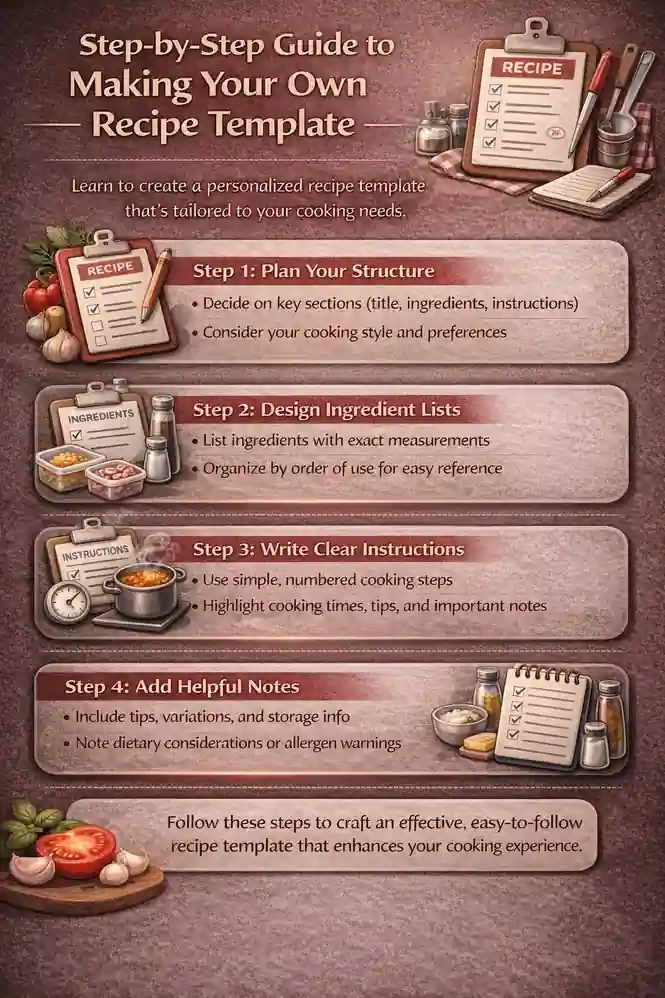
Step 2: Set the Core Sections
Every effective recipe template starts with the same essentials.
Include:
Recipe title (what you’re making)
Ingredients list (written in the order used)
Instructions (short, numbered steps)
Timing (prep time and cook time)
Notes (optional tips, substitutions, or storage)
These sections mirror how recipes are documented in training kitchens—clear and predictable.
Step 3: Write Ingredients the Way You Cook
List ingredients exactly as they’ll be used.
Instead of grouping by type, write them in prep order:
“1 onion, diced”
“2 cloves garlic, minced”
This prevents missed prep and reduces confusion while cooking.
Step 4: Break Instructions Into Single Actions
Each instruction should describe one action only.
Good templates avoid long paragraphs. Short steps are easier to follow in real time and easier to repeat later. If a step feels rushed or unclear, split it into two.
Step 5: Add Just Enough Timing
You don’t need precision to the second. You need expectations.
Include:
Approximate prep time
Approximate cook time
Visual cues when possible (“until golden,” “until tender”)
This helps beginners pace themselves and avoid over- or undercooking.
Step 6: Test and Refine the Template
Use your template on a recipe you already know.
As you cook, ask:
Did anything feel unclear?
Did I miss a step?
Did the order make sense?
Adjust the template—not the recipe—until the structure works smoothly.
Keep the Template Consistent
Once your template works, reuse it every time.
Consistency is what makes templates powerful. The more you use the same structure, the easier recipes become to write, follow, and trust.
“When we build recipe templates in working kitchens, we don’t start with design—we start with sequence. If the ingredients aren’t listed in the order they’re used and the steps don’t match how cooks actually move, the recipe fails. A good template fixes that before the food ever hits the stove.”
Essential Resources
01. Flexible Editable Recipe Template You Can Customize
https://www.101planners.com/recipe-template/
A straightforward, editable format in Word, PDF, or Google Docs that lets you start documenting recipes today — without design distractions. This mirrors how working cooks capture basics before adding cost or yield calculations.
02. Simple Google Docs Recipe Templates for Clear Structure
https://docsandslides.com/googledocs/recipe/
Clean, no-frills recipe templates designed for quick editing in Google Docs. Great for beginners or cooks who want a reliable layout they can revise on the fly — the kind of practical ordering chefs appreciate when they’re refining technique.
03. Digital Recipe Library Templates (Docs & Sheets)
https://gdoc.io/recipe-templates/
A set of editable templates for Google Docs and Sheets that helps you organize recipes digitally. Like the standardized forms in professional kitchens, these keep your recipes searchable and consistent across your collection.
04. Multi-Format Recipe Template for Cross-Tool Use
https://spreadsheetdaddy.com/templates/recipe
Templates compatible with Excel, Google Sheets, Word, and PDF give you flexibility no matter where you work. This reflects how chefs keep different tools handy — using what fits their workflow best while maintaining the same structural logic.
05. Excel Recipe Templates Built to Real Kitchen Standards
https://www.chefs-resources.com/kitchen-forms/recipe-template/recipe-templates-excel/
Professionally structured Excel templates that mirror the way chefs document recipes for consistency and control. These include scalable layouts and formatting choices that help with batch scaling and food costing.
06. Printable Recipe Sheets for Physical Use
https://gdoc.io/recipe-templates/printable-recipe-free-google-docs-template/
Google Docs printable recipe templates with clear spaces for ingredients, steps, and notes. These are perfect for binders or printed guides — similar to how line cooks carry recipe sheets during service.
07. Recipe Manual Template for Standardizing Systems
https://www.restaurantowner.com/public/DOWNLOADRecipeManualTemplate-3.cfm
A complete recipe manual template that helps you compile multiple recipes into a documented system. Professional kitchens thrive on documented systems — this gives you that same structure for your recipe collection.
These resources show how standardized recipe templates create consistency and control across tools and workflows, making it easier to document, scale, and repeat dishes—whether you’re organizing everyday meals or refining precise hake fish recipes that depend on clear structure and repeatable execution.
Supporting Statistics
The numbers below reflect problems cooks see every day when recipes lack clear structure—and why templates help control them.
1. Food Safety Depends on Clear Documentation
48 million people in the U.S. get sick from foodborne illness each year.
128,000 hospitalizations and 3,000 deaths occur annually.
Common causes in kitchens:
Missing temperature details
Skipped holding times
Unclear prep order
Recipe templates force critical safety steps to be written and followed.
Source (CDC.gov):
https://www.cdc.gov/food-safety/data-research/facts-stats/index.html
2. Food Waste Is Often a Recipe-System Failure
30–40% of the U.S. food supply is wasted.
That equals about 133 billion pounds and $161 billion in losses.
In practice, waste comes from:
Unclear yields
Inconsistent portions
Missing storage or reuse notes
Templates reduce waste by locking in quantities and handling guidance.
Source (USDA.gov):
https://www.usda.gov/about-food/food-safety/food-loss-and-waste/food-waste-faqs
3. Small Errors Scale into Big Losses
72.2 million tons of surplus food were generated in the U.S. in 2023.
Nearly 30% of total production exceeded demand.
Professional kitchens reduce this by:
Standardized recipe templates
Portion and yield discipline
The same structure works at home, just at a smaller scale.
Source (ReFED.org):
https://insights-engine.refed.org/food-waste-monitor?view=overview&year=2023
4. Waste Has Environmental Consequences
30–40% of food in the U.S. is never eaten.
Wasted food is the most common material sent to landfills.
Clear prep, storage, and leftover notes reduce unnecessary discard.
Source (EPA.gov):
https://www.epa.gov/sustainable-management-food/united-states-2030-food-loss-and-waste-reduction-goal
These statistics show that unclear recipes drive safety risks, food waste, and overproduction, while structured templates strengthen kitchen management by standardizing documentation, portions, and processes that protect health, reduce loss, and improve efficiency.
Final Thought & Opinion
In real kitchens, structure is what keeps recipes working under pressure. After hands-on experience with recipe documentation, one thing is consistent: clear formats prevent breakdowns before they happen.
Recipe templates deliver practical benefits:
Fewer missed steps
Clear timing and prep order
Reduced errors and rework
Greater consistency and confidence
Templates aren’t restrictive. They remove friction so cooks can focus on what matters most:
Flavor
Technique
Refinement
The key shift is treating templates as tools, not paperwork.
A good recipe template isn’t about writing better recipes—it’s about producing better outcomes, every time, supporting efficient systems that align with principles like Self-sustаіnіng farming through reduced waste, smarter planning, and repeatable results.
FAQ on Recipe Template
Q: What does a recipe template actually do?
A: A recipe template acts as a cooking workflow. It organizes ingredients, steps, and timing in a logical order so results are easier to repeat.
Q: Why do professionals rely on recipe templates?
A: In real kitchens, consistency matters more than improvisation. Templates reduce errors, speed up training, and help ensure dishes turn out the same every time.
Q: Are recipe templates useful for beginners?
A: Yes. Templates remove guesswork and guide beginners clearly from preparation through completion.
Q: What makes a recipe template effective?
A: An effective template lists ingredients in prep order, uses short action-based steps, includes clear timing, and leaves room for notes that prevent common mistakes.
Q: Do recipe templates limit creativity?
A: No. When structure is handled by the template, cooks can focus more on flavor, technique, and improvement rather than fixing unclear instructions.